clarinsi4ai
Lexical and knowledge resources
← Overview · Part of CLARIN.SI resources for AI development · Data as of 22 October 2026
Slovenian is unusually well covered by open, machine-readable lexical data: a 372k-lemma morphological lexicon (Sloleks 3.1), two wordnets, a 102k-entry thesaurus and a 78k-entry collocation dictionary, all under CC BY-SA or more permissive licences. For AI work these resources seed instruction and QA data (as in SloLexQA), support lexical probes and benchmarks (as in SYNDIST and COLLDIST), ground generation through retrieval, and help evaluate tokenisers and morphology.
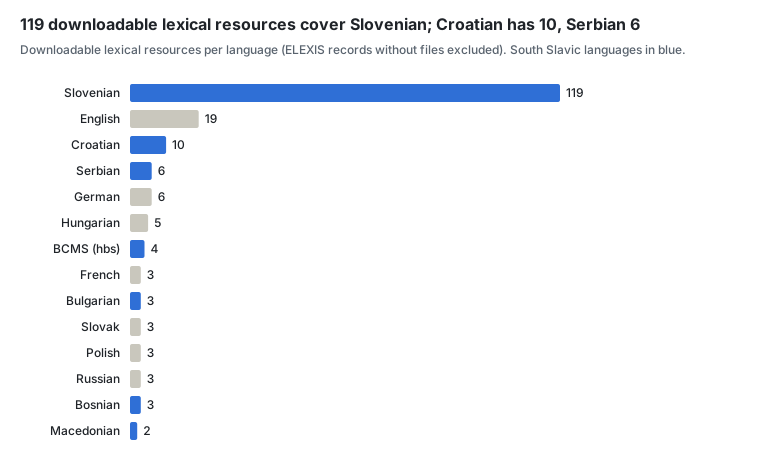
A multilingual resource counts once for each of its languages.
Sections: Dictionaries and lexical databases · Morphological and phonological lexicons · Semantic, collocation and sentiment lexicons · Terminology · Frequency lists and n-grams · ELEXIS dictionaries
Dictionaries and lexical databases
Morphological and phonological lexicons
Slovenian, including multilingual resources with Slovenian
Other languages
| Resource | Languages | Size | Licence | Year |
|---|---|---|---|---|
| Inflectional lexicon srLex 1.3 | sr | 169.3k entries | CC BY-SA | 2019 |
| Inflectional lexicon hrLex 1.3 | hr | 164.2k entries | CC BY-SA | 2019 |
| MULTEXT-East non-commercial lexicons 4.0 | 5 languages | 2.3M entries | MULTEXT-East (NC) | 2010 |
Semantic, collocation and sentiment lexicons
Slovenian, including multilingual resources with Slovenian
Other languages
| Resource | Languages | Size | Licence | Year |
|---|---|---|---|---|
| Automatically constructed multiword lexicon hrMWELex v0.5 | hr | 43.7k entries | CC BY | 2015 |
| Automatically constructed multiword lexicon srMWELex v0.5 | sr | 22.3k entries | CC BY | 2015 |
| Croatian SenseGraph 1.0 | hr | 649 words | CC BY-SA | 2018 |
Terminology
Frequency lists and n-grams
These resources are derived from Gigafida, Gos, Trendi, Janes, KRES, Šolar and Učbeniki. For AI work they mainly help with tokeniser design, vocabulary coverage checks and data filtering.
ELEXIS dictionaries
134 records describe dictionaries contributed to the ELEXIS project in 61 languages; the most frequent are French (22), English (21), German (20), Slovenian (16), Serbian (13), Danish (12) and Lithuanian (11). None of these records has files or a licence in the repository: the data is hosted elsewhere, and access goes through each provider. The full list is in the spreadsheet.
Other stages: Pre-training data · Speech and multimodal data · Post-training data · Evaluation and benchmarks · Lexical and knowledge resources · Models and tools